

Yunnan - A round trip from Kunming via Dehong to Pu'er - Travel planning:
The round trip from Kunming through the Dehong Autonomous Prefecture to Pu'er was planned for nine days. March is the most pleasant time of year to travel in the tropical part of Yunnan Province.
In order to lose as little time as possible, we took the flight to Kunming late in the evening from Beijing. The flight time is about four hours. The return flight to Beijing, we took from Pu'er.
Both, the city of Mangshi in the autonomous prefecture of Dehong and the city of Pu'er are also best reached by plane.
Kunming, the capital city of the Yunnan Province:
The arrival in Kunming was late in the evening. Therefore, the Borrmann Hotel was the best choice, as it is located close to the airport. In addition, the onward flight to Mangshi was planned early in the morning. In order to make the most of the time in Kunming, I decided to visit the Dianchi Lake from the western mountains in the afternoon. The lake and the mountains can easily be reached from the airport by subway.

The area around the western mountains, which due to their shape are also called "Sleeping Buddha Mountains", is ideal for a long spring walk.


In addition to traditional buildings and colorful corridors, there are also a few temples in the mountains. Unfortunately, due to the high humidity, the Dianchi Lake was almost invisible from above.


From the western mountains we headed towards the city center in the late afternoon. On the university campus and in the surrounding parks, many local children and young people were outside, wearing traditional clothes and using the spring days for a photo shooting.

At sunset in March it is already getting significantly cooler, the parks become empty and the night markets are opening their doors.


The night markets are typical for southern China. Colorfully illuminated, they invite you to stroll and try things out. Local specialties and drinks from all over the world are offered everywhere. The ideal place to strengthen yourself with various small delicacies and to end the evening.
The next morning, the plane departed to Mangshi, the capital city of the autonomous prefecture of Dehong.
The Hotel Phalaka in Mangshi:


As starting point to visit the city of Mangshi, as well as to drive through the autonomous prefecture of Dehong, I have booked the Hotel Phalaka for three nights. The modern and luxuriously furnished hotel opened in 2020. The most important sights of the city can either be reached on foot or easily by taxi.
There are also numerous excellent restaurants in the close circumstance of the accommodation. The included breakfast buffet is large and international.


The rooms are spacious, clean and modernly furnished. The hotel complex also has an outdoor pool that can be used until the evening hours.


In the evening you can while away the time swimming or walking around the hotel complex. Small shops, cafés and restaurants can be found in the side streets.
Mangshi, the capital city of the autonomous prefecture of Dehong:


After checking in at the hotel in the late morning, the discovery tour through Mangshi began. Passing interesting buildings and the tropical gardens of some restaurants, we were heading towards the city center.


Arriving at the town square, things get lively. This is where people are meeting during the weekends passing the time with board games. In addition to card and board games, traditional games such as Majiang and Chinese chess are played as well.
Social entertainment is very popular across the country. When it gets dark, the games are packed away and people start dancing together.


Not far from the city square you come across a small temple of a special kind. Completely overgrown by a huge tree, the temple is known far beyond Mangshi.


The palm-lined streets are lined with international shops, while in side streets fresh fruits are sold from old fashioned vehicles.


Even after dark, the Buddhist buildings in the city are worth seeing and impressive.


After an extensive discovery tour by walking through the city of Mangshi, it was time for a refreshment.

The specialties of the Yunnan cuisine can best be enjoyed in the middle of the restaurant´s beautiful garden.


The next morning, we took a taxi to Mangshi's main attractions, the Golden and the Silver Pagoda.
On the way, it was a good idea to visit the tropical garden with its well worth seeing architecture.

One of the resident peacocks took the opportunity to pose for a photo.
Then we took a taxi to the real highlight of the city - the two pagodas on a hill.
The Golden and the Silver Pagoda of Mangshi:

Truly a magnificent view when you look up at the golden pagoda from in front of the stairs. Not only the size, but also the numerous decorations and the attention on the details makes this building special. Visiting this sight is a must when traveling in Mangshi.


Numerous other details can be discovered while going upstairs. Among others, there are elephants, considered as sacred animals of Buddhism.
Once at the top, the pagoda shows itself in all its glory.


The inside of the pagoda can also be visited or used for praying. If you want to enter the pagoda, you have to take off your shoes before. The interior may only be entered barefoot.


Not far from the Golden Pagoda, on another hill, is the Silver Pagoda.
A small, well-kept park leads directly to the pagoda, from where you can watch a magnificent sunset when the visibility is good.


After dark, the two pagodas are festively illuminated and are then already visible from the city.

At least as impressive at night as during the day - the golden pagoda in the city of Mangshi.
A day trip thorugh the autonomous prefecture of Dehong:
After breakfast, a driver organized by the Hotel Phalaka took us on a tour through the autonomous prefecture of Dehong to the border of Myanmar.

On the way you will find tropical parks with impressive waterfalls. A visit is definitely worthwhile.


In the border city of Ruili there are excellent restaurants where you can have lunch.
Then we drove on to the border with Myanmar.


The special vehicles, which supply the trees along the roadside with water through artificial rain, are interesting to see.
Shortly afterwards, the border to Myanmar is reached, but due to the pandemic, it can only be crossed in exceptional cases.

Also near at the border city of Ruili, there is a Buddhist park that is located directly on the border fence with Myanmar. From a glass bridge, you get a great overview.
The settlement at the top right of the photo already belongs to Myanmar. Afterwards the driver took us back to the accommodation in Mangshi. On the way we had to endure a few controls related to the pandemic, so that we reached the hotel after dark.
Day tour from Mangshi to Tengchong:


The drive from Mangshi to Tengchong first takes us through rural areas.
In addition to blooming rapeseed fields, we also find a small strawberry plantation, where you can pick the fruity, fresh food for the road yourself.


Then we visit an old minority village and get to know the typical life there. At lunchtime you can try freshly prepared dishes in one of the small restaurants in the village.
A visit to the hot springs in the volcanically active area is planned for the afternoon. In the evening we continue to the old town of Tengchong, to our next accommodation.
Volcanic hot springs in Tengchong:


Hot, steaming streams, towering hot water geysers and the smell of sulfur in the air. The volcanic activity in the area can clearly be seen here.

Passing typical Chinese pavilions and crossing old stone bridges, it goes steadily uphill to the main hot springs in this area.


Arriving at the summit, at the hot springs, you can immediately see the additional benefit of the released energy. Here, with the help of the volcanic waste heat, eggs are boiled and sold to have a try.


If climbing the mountain was too exhausting, you can find a way to relax your muscles and prevent sore muscles here. A footbath in hot water relieves cramps and improves blood circulation.
The oldtown of Tengchong:


In the late afternoon we reached Tengchong, where I stayed at the Hetang Zhenmei Panoramic Holiday Inn hotel for the night. Not as luxurious as the Hotel Phalaka in Mangshi, but all the more lovingly furnished. Even a bathtub with connection to the hot spring is integrated in the room.
The breakfast is relatively simple and typically Chinese, but you get fresh Yunnan coffee in return.
If you like the Yunnan coffee, you can buy it directly at the hotel to take away.


After checking in at the accommodation there was still enough time to explore the old town of Tengchong, to walk through the narrow streets and alleys and to look at the small shops.


The small shops in the old town of Tengchong are lovingly furnished, perfect for passing the time in the evening. In between you will always find small but good restaurants to stop off at.

A shop for buying traditionally produced wines and spirits can also be found in one of the numerous small streets.
The Tengchong Bird Sanctuary:
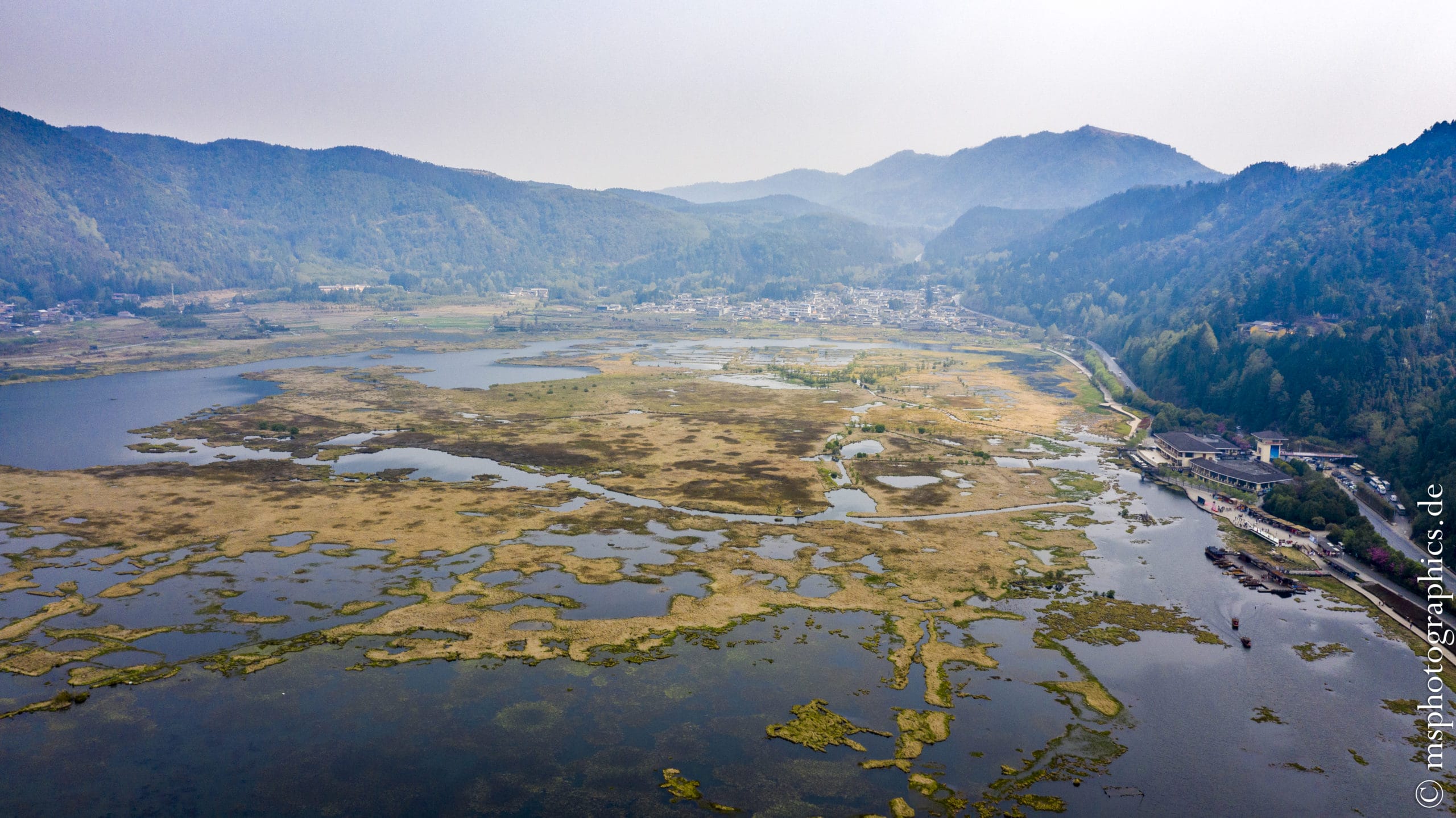
Before we had to take the onward flight to the Pu'er tea-growing region in the afternoon, we used the time in the morning to visit the bird sanctuary in Tengchong.

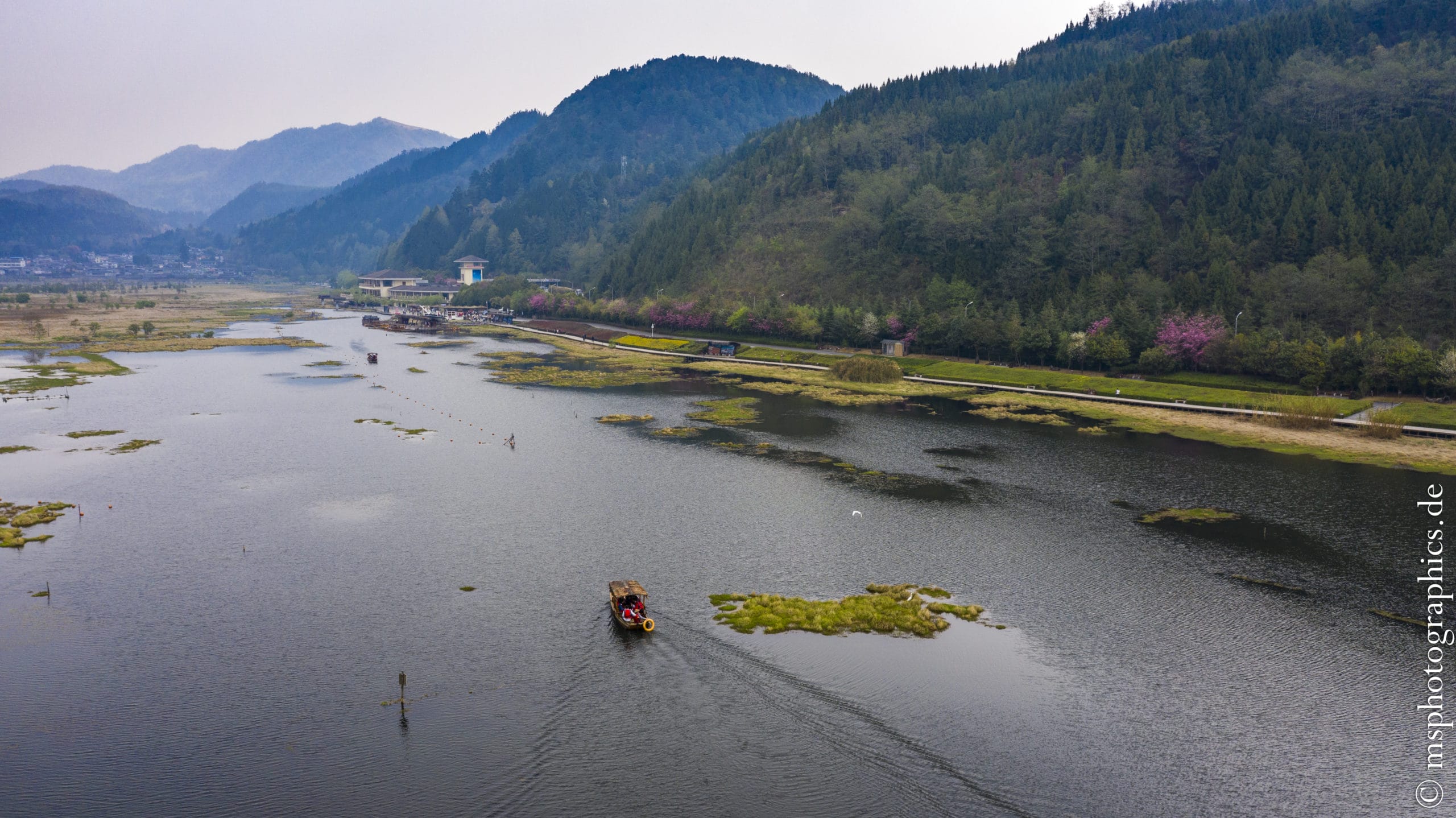
The swamp area, which can be explored either by walking or by boat, is home to numerous rare bird species. With a bit of luck you can see them from time to time.
Unfortunately it was windy and cool that day, so the birds could only be seen from afar and mostly in flight.

If you want, you can have a photo taken with a white yak in front of the mountain backdrop for a fee.

Then it was time for the onward flight. With a group of women in the traditional clothing of the minorities, we flew from the airport in Mangshi to Pu'er.
In the jungle of Pu'er:


Far away from the city, I have booked the hotel Red Panda Manor Pu'er for two nights. The small bungalows with their own terrace and spacious living and sleeping areas are located in the middle of the Pu'er jungle.
The restaurant is about a 15-minute walk or easily accessible by one of the electric shuttle buses.
There is a rich breakfast buffet as well as typical and good Yunnan cuisine for lunch and dinner.
In addition, the hotel offers numerous interesting activities, such as a nocturnal search for insects or traditional tea making process.
Furthermore, extensive, guided half-day or day tours through the jungle are on offer. These are approved at short notice in consultation with the local rangers. Unfortunately, we were denied access because of a nearby herd of elephants.


A wonderful view from the restaurant over the swamp landscape and over the tea plantations.
From tea leaf to tea – tea picking in Pu'er:

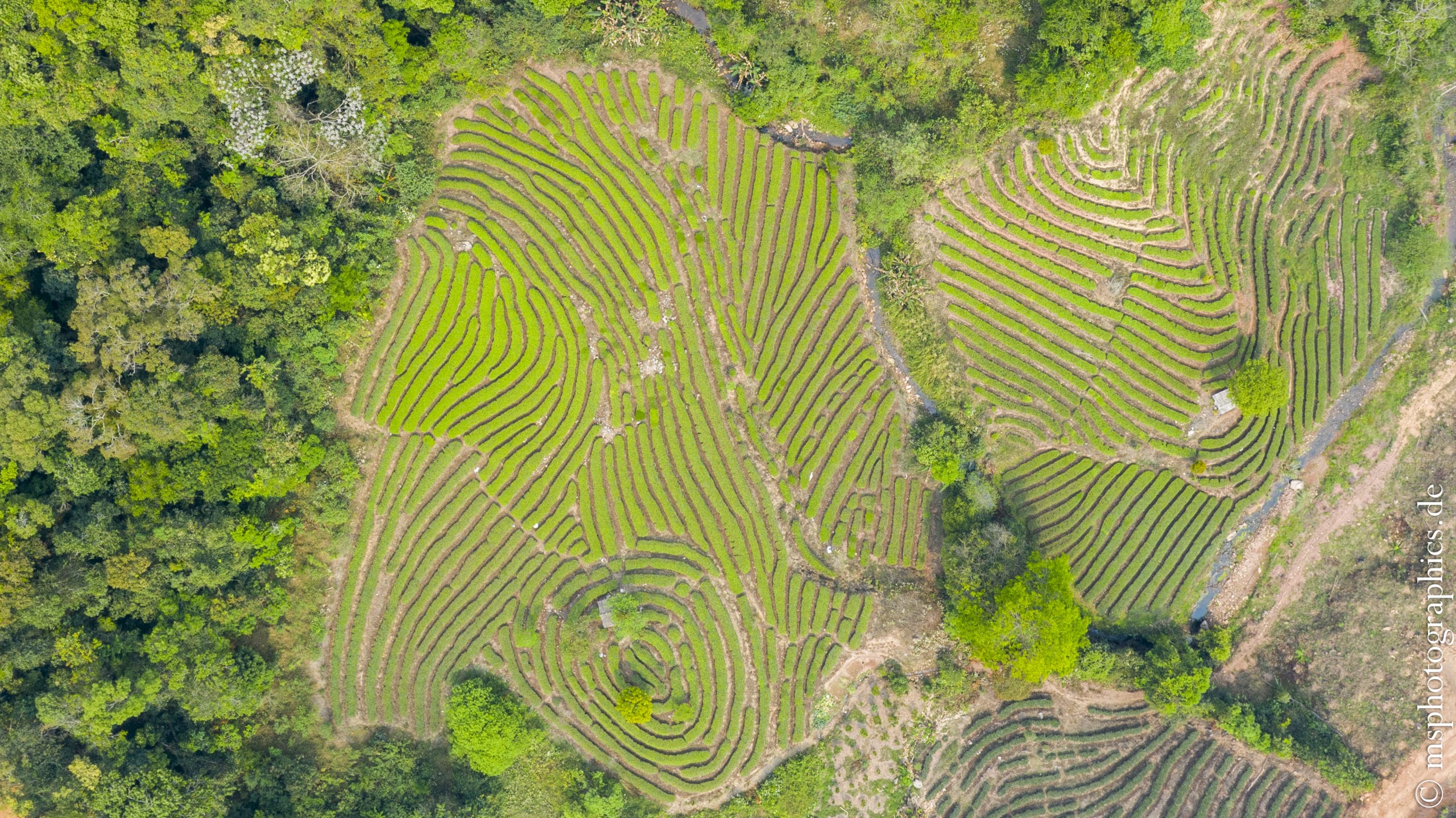
Tea picking in Pu'er is something not to be missed. The Pu'er tea is known far beyond the borders of China and the experience of making this tea yourself is something special.


With a basket and hat, we walking into the tea field to pick leaf by leaf. A tedious but relaxing activity.
In addition to tea, you can also find orange trees on the plantation. The tasty fruits may also be picked and eaten.


After a good two hours, a sufficient quantity has been picked to be able to continue with further processing.
The freshly picked tea must now be boiled in order to achieve good pre-drying. The leaves must be constantly mixed well to avoid burning on the hot surface of the cooker.


Finally, the pre-dried tea is dried in the fresh air for another 12 - 24 hours, depending on the weather.
The finished tea can be kept for up to 40 years and of course you can take it home with you.


If you are lucky, you can meet various birds and monkeys in the forest as well as the small, cute red pandas, which go their way relatively unimpressed by the visitors.
Unfortunately, after two days in the jungle, it was time to go back to the city. Having booked the flight to Beijing for early in the morning, I reserved the Mandy Boutique Hotel for one night. This accomodation is located just behind the runway of Pu'er Airport.
Conclusion:
The round trip from Kunming via Dehong to Pu'er in Yunnan was characterized by cultural highlights and unforgettable experiences.
In addition to the hustle and bustle on the campus and at the night market in Kunming, imposing Buddhist buildings in Mangshi, spectacular landscape and nature in Tengchong, the experience of being able to make the well-known Pu'er tea myself was something very special.
Those who like to travel a little off the main tourist routes will find what they are looking for in these places and for them this trip is an absolute recommendation.
This report is part of my series China travel reports – there you will find an overview of all regions.
0 Comments